


By Michael Pates, Executive Editor
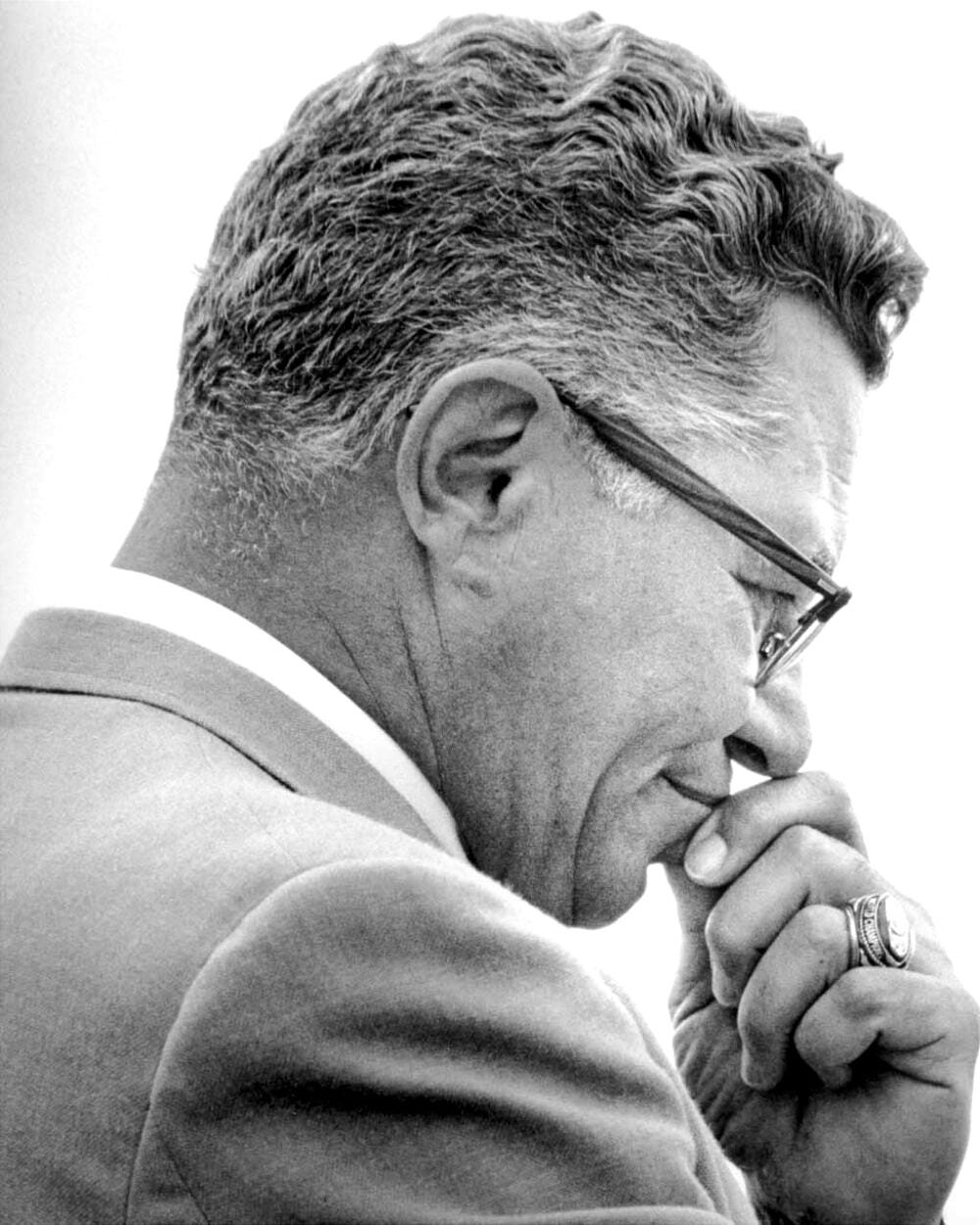
I wish to hell I’d never said the damned thing. I meant the effort … I meant having a goal …. I sure as hell didn’t mean for people to crush human values and morality.
— Vince Lombardi, legendary football coach, lamenting his best-known edict, “Winning isn’t everything; it’s the only thing.”
It’s not whether you win or lose; it’s how you play the game.
— Grantland Rice, legendary sportswriter
As Vince Lombardi really meant and Grantland Rice keenly observed, a fair competition has moral benefits that advance human achievement beyond simple victory or defeat: In the process of competing, the competitors also improve themselves, each other, and the game itself; and, for humanity as whole, these benefits expand our collective sense of possibility.
Ditto the merits of competition as expressed in democracy and capitalism. Democracy is a competition of ideas. So is capitalism. Whether the competition is good or bad for everyone affected depends on the rules of the game, who gets to makes them, and to what end.
At its best, democracy fosters a fair economic playing field and equal opportunity to enter it; while capitalism, at its best, helps drive the pursuit of individual potential, cutting-edge innovation, and economic growth for the benefit of all. It is the job of politics (and thus of democratically elected politicians) to make rules that achieve these outcomes, or that at least approximate them in a balanced way that’s broadly accepted, adaptive, and sustained, so that the competition, and everyone who affects and is affected by it, can flourish. Call it Democratic Capitalism (cuz that’s what it is).
Today, though, an historic and staggering American wealth gap, and the toxic politics that have fed it (and that it now feeds), reflect greed in the extreme. The failure of politicians to prevent and correct this imbalance therefore leaves both democracy and free-market capitalism at unprecedented risk of descent into autocracy. In response, with capitalism itself increasingly blamed for what are, in fact, political failures, some are advocating its replacement with Democratic Socialism, described further below.
In considering this call, however, ‘tis well to first revisit and reassert fundamental premises. Namely, the self-evident democratic truths proclaimed in the Declaration of Independence (human equality, pursuit of happiness, consent of the governed, etc.) and the simple, seemingly undeniable notion that economies exist to serve human needs, not the other way around — people don’t exist to serve economies. This means that individual entry into, and benefit from, either economic system is also a community service to be regulated toward maximum communal benefit, such that the economy empowers individual initiative and meets everyone’s essential human needs — because that’s what an economy, fundamentally, is for.
Accepting these premises, the next basic questions are: 1) what are those human needs, and 2) which economic system, Democratic Capitalism or Democratic Socialism, better serves them?
The Needs
In 1943, Abraham Maslow famously posited a “hierarchy” of human needs:
physiological (food, shelter, warmth, sleep);
safety (resources, security);
belonging (connection, love, relationships)
esteem (prestige, achievement, recognition); and
self-actualization (personal growth, achieving potential, self-fulfillment).
While some scholars question the substantive and/or operational adequacy of Maslow’s formulation, it nonetheless represents a basic set of relatable and dynamic human needs that any economic system must serve to be suited to its purpose. The fact that the needs as-lived are all mutually reinforcing, interdependent, and ultimately irreducible only underscores the systemic challenge.
The first two needs in Maslow’s hierarchy are about survival. The last two are essentially about ambition. And the third is arguably a two-way bridge between them. Thus, any economic system must a) enable human beings to survive, b) empower them to thrive and, in the process, c) also engender a sense of meaning and connection amongst individuals and to larger society — that their lives matter equally and that their ambitions, be they grand or modest, can be pursued honestly, if not always be fully realized.
The System
Given the vagaries of human nature, of course, that’s a mighty tricky balance for any politico-economic system to achieve and sustain. The question is, which system is more capable of doing so? Or, more precisely, which one is better able to receive and accommodate varied, competing, and even contradictory political inputs and at least roughly translate them into economic policies that are sustainably productive and broadly rewarding?
Some argue, and with increasing electoral success (see, most recently, Zohran Mamdani in New York City), that it’s Democratic Socialism, which is defined as a
political ideology that supports the establishment of a democratically run and decentralized form of socialist economy. Modern democratic socialists vary widely in their views of how a proper socialist economy should function, but all share the goal of abolishing capitalism rather than improving it through state regulation (as preferred by social democrats). They also prioritize democracy as an end over democracy as a means, and some democratic socialists see revolution as an acceptable method of achieving the democracy they desire.
While Democratic Socialists in the United States (most famously, Bernie Sanders) vary widely in their specific aims, classic socialism holds (unlike Sanders) that the means of production should be publicly owned or controlled. While this approach is often justified as ensuring a basic and broadly shared level of material security (Needs 1 and 2 in Maslow’s hierarchy), it also tends to stifle individual innovation and, by extension, the collective economic growth that, under Democratic Capitalism, private ownership and investment incentivize — which, arguably, dampens esteem and self-actualization (Needs 4 and 5).
To the extent, though, that some if its adherents (like Sanders) seek merely to regulate private ownership, Democratic Socialism shares much in principle with Democratic Capitalism, but with important differences mainly in what, and how much, to regulate. And these distinctions can be said to be manifested in the social dimensions that meet on the two-way conceptual bridge that Need 3 (“belonging”) represents.
Among the economic sectors that Democratic Socialists propose to regulate most intensively — often to the point of making them ‘free-of-charge’ to the individual (except, of course, through taxation) — are healthcare, higher education, and public transportation. As it happens, to the extent they promote individual well being, talent development, and economic mobility, respectively, these sectors are the ones perhaps most essential to the success of Democratic Capitalism. (Two others are housing and food security, which can be advanced dramatically by ensuring access to the first three.)
And this is where private-production Democratic Socialism and Democratic Capitalism conceptually meet in the middle — on the Need 3 bridge, as it were. What Democratic Socialism argues from a moral-imperative position, Democratic Capitalism can also argue from a competition-as-moral-benefit perspective. That is, when a Democratic Socialist argues for single-payer healthcare for moral reasons — that no one should lack reliable access to quality healthcare in the richest nation on Earth — the Democratic Capitalist can also favor as a boon to broader market-based competition, freeing employers from the costly burden of providing employees’ health insurance while increasing workforce health benefits and outcomes. In other words, employer-based health insurance is anti-competitive, and the best solution is to have government (‘us’ in a democracy) guarantee it. The same logic applies to higher education and public transportation — guaranteeing access thereto not only honors basic human dignity by serving Needs 1 and 2, it also enhances the moral benefits of economic competition, thereby facilitating Needs 4 and 5. In the process, Need 3 — belonging — both serves and is served.
All it requires is money. And, therefore, politics.
The Politics
Politics is where it’s how you play the game meets economies serve human needs, not the other way around. It’s where the rules of the game are made — the democratic in both Democratic Socialism and Democratic Capitalism.
Central to this construct is the notion of ownership: Not who owns which material things, necessarily, but who owns the power of decision over who will be taxed on which sources, at which percentages, and for which purposes. This question, and the answers to it, define the relative merits of Democratic Socialism and Democratic Capitalism.
The answer that currently predominates in the United States, as reflected in fiscal and monetary policy and as manifested in the aforementioned wealth gap, is that those who have acquired the resources are, by right, entitled to keep them with minimal-to-no taxation, lest they be unjustly confiscated for purposes other than those decided by their rightful possessor. In short, the power of decision over the disposition of resources rightfully rests with those who possess them. The wealth gap is therefore a justifiable consequence of this moral logic — if people want to possess more resources, they, too, should exercise their freedom to generate more resources and not ‘take’ them from those who have already done so. And this logic extends to using one’s freedom and resources to write the political rules to better ensure that possessors get to keep for themselves the maximum possible share of those resources.
Of course, such logic defies the fundamental premise that economies exist to serve human needs, not the other way around. The fact that an economic actor has profited from using the economic system to meet one or more human needs does not justify that actor’s hoarding the profits acquired thereby and, in turn, inhibiting the further meeting of needs to which some share of those resources could be put. That’s the essential Democratic Socialist argument.
That said, the actor is entitled to rewards for having successfully taken financial and other risks that proved broadly beneficial. Under Democratic Socialism, public ownership of the means of production, or excessive taxation of the rewards of successful risk-taking, or constrictive regulation of means and methods, threaten the willingness to take personal risks by which larger society might benefit. That’s the essential Democratic Capitalist argument.
Yet a healthy democratic politics will recognize that both are right — the Democratic Capitalist, in gauging the risk-reward inputs and the Democratic Socialist, the rewards-to-needs outputs — and will regulate the shared economy to calibrate their meeting in the middle of the Need 3 bridge. Such regulation will manifest the self-evident (but oft-ignored) truth that, no matter how much wealth one has generated, no economic actor owns the economy or any sector thereof, which, as a facet of the shared economy, belongs to all to meet the needs of all. (See, for example, the current tech sector, which owes its existence to taxpayer-funded government research.) Thus, Democratic Socialism and Democratic Capitalism together serve this essential needs-meeting economic purpose in ways neither could do alone.
The Winning
So, what does ‘winning’ look like in this competition toward both individual and shared well being and improvement? Fundamentally, it means 1) ensuring equal opportunity to get in the game, take risks, and develop individual talent/potential/ideas; 2) building and maintaining a social infrastructure to honor basic human dignity under all circumstances; and 3) establishing a culture in which the first two are mutually reinforcing, not antagonistic.
To attempt to list here the ways in which the foregoing could and should be manifested across the broad sweep of economic endeavor would be virtually impossible and not particularly useful, though many of the broad themes — such as the relationships between government and governed, management and labor, domestic and foreign policy — are obvious and intuitive. That said, in light of the foregoing discussion, the animating question for any and all of these considerations is essentially the same:
What’s the human rights and rule of law answer?
Whether at the national, regional, or global level, the sources for addressing this pivotal question, whatever the specific context in which it is posed, are rich and wide-ranging. International instruments include, among many others, the International Bill of Human Rights (comprised of the Universal Declaration of Human Rights; the International Covenant on Civil and Political Rights; and the International Covenant on Economic, Social, and Cultural Rights); the Geneva Conventions; the Convention on the Elimination of All Forms of Discrimination Against Women; the Convention on the Elimination of All Forms of Racial Discrimination; and, more recently, the UN Guiding Principles on Business and Human Rights. These and related instruments, developed and refined over many decades of multifaceted experiential, intellectual, political, and cultural engagement, encompass the dynamic elements of both Democratic Capitalism and Democratic Socialism in meeting human needs.
Not incidentally, the inspiration for many of these instruments sprang from the global destruction of World War II — which was wrought and facilitated by extreme greed, whether for power, money, or both — and from a globally shared commitment thereafter to prevent a third one. And they were secured by politics — bold, savvy, nuanced, realistic, and dedicated to the public interest.
Indeed, even before World War II, the global economic devastation of the Great Depression had set the stage for both internal strife and international armed conflict. In the United States, as he sought to ameliorate that suffering, preserve democracy, and save capitalism from itself with his tax-funded New Deal programs — which, in effect if not in fact, were arguably the most comprehensive public-policy attempt in history to meet Maslow’s hierarchy of needs — President Franklin Roosevelt confronted directly the monied forces — the greed — that sought to defeat him. Campaigning for re-election in 1936, he declared that:
[g]overnment by organized money is just as dangerous as government by organized mob. Never before in all our history have these forces been so united against one candidate as they stand today. They are unanimous in their hate for me, and I welcome their hatred.
I should like to have it said of my first administration that, in it, the forces of selfishness and of lust for power met their match. I should like to have it said of my second administration that, in it, these forces met their master.
Master, indeed. If we are to master capitalism to achieve its communal purpose as an economic system, we must first master ourselves, lest capitalism master us all and we become its servants (see the aforementioned wealth gap). That means incorporating the elements of Democratic Socialism that facilitate the sharing of the fruits of capitalism. And that facilitation, in turn, will be a product of democratic politics that generate an authentic Democratic Capitalism.
The Pursuit of Happiness
Such self-mastery may well begin, in part, with redefining the current capitalist notion of ‘success.’ To the extent that it is equated with relative financial wealth, success is entirely misunderstood and self-defeating. While it may be fair to say that most people would ‘like’ to be wealthy, that doesn’t mean they would ‘like’ — actually be happy — doing anything that wealth creation requires. A kid who dreams of being a cop won’t get rich on that track, but, to the extent she becomes a great cop, will be equally as ‘successful’ as the kid who’s living his dream of being a great teacher, and just as much as they who invented the next game-changer technology — and who owes their resultant wealth in part to the great cops who kept everyone safe and the great teachers who nurtured everyone’s talents (and the great staff who kept everyone’s streets and schools clean, et al., et al.), not to mention the workforce who most directly contributed to the profitability of the enterprise — all of whom have an equally just claim to share in the wealth through a commensurate level of pay and public services that best meets their needs, one through five. That will be a virtuous Democratic Capitalism.
So, go forth and prosper. Innovate and compete and fail and fail again and succeed.
Be a capitalist.
But don’t be a dick about it.
#TreatPeopleRight
My thanks to Lew Diggs for his helpful comments on a previous draft of this article.